For decades, the HVAC industry has operated on a simple principle:
Knowledge was the most valuable asset a technician could possess.
If an air conditioner stopped working, someone had to determine why. Was it a failed capacitor? A bad contactor? A refrigerant issue? A control board? A compressor? An airflow problem? A thermostat? There are hundreds of possible failures, and accurately identifying the problem has traditionally taken years of experience.
That experience became the industry’s most valuable commodity.
It also created an interesting paradox.
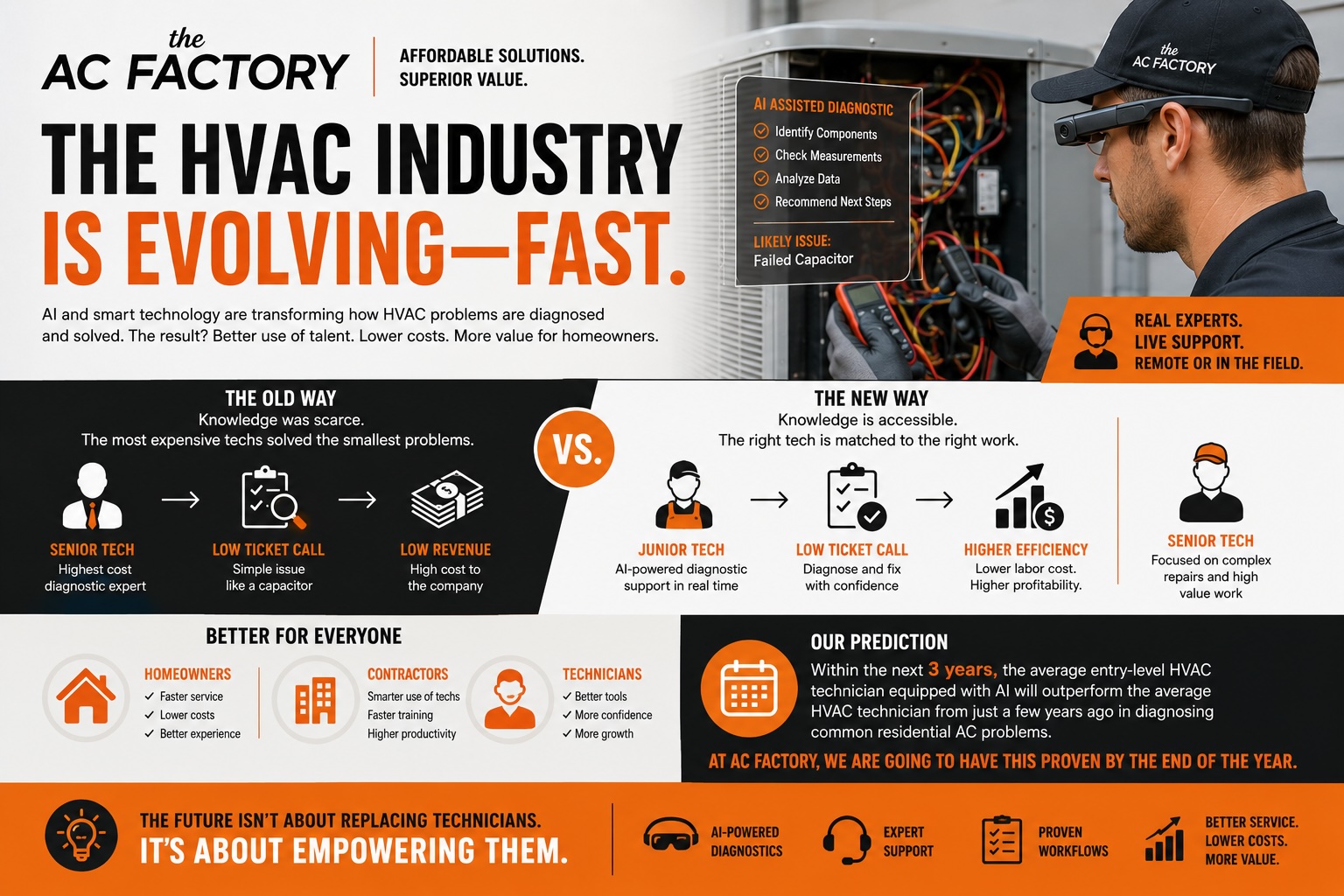
The highest-paid technicians in most HVAC companies often spend much of their day diagnosing some of the lowest-dollar repairs.
Meanwhile, less experienced crews install complete systems that generate the largest invoices for the company.
For years, that’s simply been how the industry worked.
Not because it was the most efficient model.
Because it was the only model.
We believe that’s about to change.
The Real Product Was Never the Repair
Most homeowners assume they’re paying for someone to replace a part.
In reality, they’re paying someone to know which part needs replacing.
Replacing a capacitor isn’t particularly complicated.
Replacing a contactor isn’t particularly complicated.
Clearing a clogged condensate drain isn’t particularly complicated.
The difficult part has always been knowing with confidence what actually failed.
That diagnostic knowledge has historically belonged to experienced technicians who spent years learning from thousands of service calls.
Until now.
AI Doesn’t Replace Technicians. It Replaces Scarcity.
One of the biggest misconceptions about artificial intelligence is that it’s coming to replace skilled trades.
We don’t believe that’s what’s happening.
We believe AI is replacing the scarcity of diagnostic knowledge.
Imagine a junior technician wearing AI-enabled smart glasses.
The technician opens an electrical panel.
The AI identifies the components, requests a few electrical measurements, compares the symptoms against millions of data points, and walks the technician through a structured diagnostic process while a senior expert is available remotely if needed.
The technician still performs the work.
The technician still needs mechanical ability.
The technician still needs to understand electrical safety.
The technician still needs to earn the homeowner’s trust.
What changes is that years of accumulated diagnostic knowledge become available instantly.
Instead of spending ten years becoming a great diagnostician, a young technician can begin performing at a much higher level almost immediately.
The Industry Has Been Structured Backwards
For decades, contractors have had little choice.
The company’s most experienced, most expensive technicians were sent to diagnose nearly every service call because only they possessed the knowledge to accurately identify the problem.
Ironically, many of those calls resulted in relatively inexpensive repairs.
At the same time, lower-paid installation crews were performing the highest-ticket jobs in the company.
That imbalance has always existed because diagnosis required years of experience.
As AI makes diagnostics more accessible, we believe the workforce naturally rebalances.
Junior technicians become capable of handling many common service calls.
Senior technicians become increasingly focused on the complex work where their experience creates the greatest value:
- Major electrical failures
- Variable-speed equipment
- Refrigeration diagnostics
- Compressor failures
- Commercial systems
- System design
- Complex airflow issues
- Equipment replacements
- Commissioning
That isn’t replacing experienced technicians.
It’s deploying them where they’re most valuable.
Contractors Win. Homeowners Win.
When contractors can match labor costs more closely to the complexity of the work, everyone benefits.
Training becomes faster.
Scheduling becomes easier.
Technicians become productive sooner.
Companies can confidently hire and develop younger technicians without waiting years before they become effective diagnosticians.
Most importantly, the cost of delivering service begins to decrease.
And in competitive markets, those savings don’t stay inside the company forever.
Some become faster response times.
Some become better customer experiences.
Some become lower prices.
Ultimately, homeowners should receive better value because technology reduces the cost of solving many common HVAC problems.
That’s exactly how innovation is supposed to work.
What Happens to Experienced Technicians?
Some people hear this and assume experienced technicians are in trouble.
We see the opposite.
The industry’s best technicians aren’t becoming less valuable.
They’re becoming more specialized.
Instead of spending half the day diagnosing failed capacitors or contactors, they’ll increasingly focus on the complicated problems that truly require decades of experience.
Their expertise doesn’t disappear.
It scales.
One senior technician can now support an entire team instead of working alone.
That’s a much more powerful use of experience.
Our Prediction
Here’s our prediction.
Within the next three years, the average entry-level HVAC technician equipped with AI-assisted diagnostics will outperform the average HVAC technician from just a few years ago when it comes to diagnosing common residential air conditioning problems.
Not because they’ll be smarter.
Not because they’ll work harder.
Because they’ll have dramatically better tools.
Every major industry has experienced this shift.
Pilots fly with advanced avionics.
Mechanics use computerized diagnostics.
Doctors rely on AI-assisted imaging and decision support.
HVAC is simply next.
We’re Building That Future Today
At AC Factory, we’re not waiting to see whether this happens.
We’re building it.
By the end of this year, we expect to demonstrate that a properly trained junior technician, equipped with AI-assisted diagnostics, remote expert support, standardized troubleshooting workflows, and wearable technology, can accurately diagnose many of the most common residential HVAC failures with a level of consistency that has historically required years of field experience.
That’s an ambitious goal.
We believe it’s also an achievable one.
Our vision isn’t to replace technicians.
Our vision is to make every technician dramatically more capable.
Because when expertise can be shared instantly, everyone wins.
Contractors become more efficient.
Technicians become more productive.
Training becomes faster.
And homeowners receive better service at a lower overall cost.
That’s the future we see.
And we believe it’s arriving much sooner than most people think.